Blog | Justin Moy visits Modalis: ‘The fact that there is commercial interest in a treatment is astounding’
During the international LAMA2 Conference in Istanbul, fellow patient Justin Moy met Simon Moore from the biotech company Modalis. Justin lives with the rare muscle disease LAMA2-MD himself and is also conducting research into the condition at Boston University. Following their initial meeting at the conference, he was invited to visit Modalis’ headquarters and research facilities in Massachusetts. In the blog below, Justin shares his personal experience, offers a behind-the-scenes look at the company, and explains how Modalis is working toward a potential treatment for LAMA2-CMD.
You never know where a conversation about tacos will lead… At the 3rd LAMA2 International Conference in Istanbul, I was one of the few Americans there, so it came to my surprise the Japanese company Modalis had sent an American, Simon Moore, and that their office was in Waltham only 30 minutes away from where I live. What had started in Istanbul as a discussion of where to get the best tacos in Waltham, eventually turned into a full fledged tour of Modalis’s research and development facilities and of course a taco lunch!
 Modalis was founded in 2016 as a Japanese company; however, their entire research and development is run in Massachusetts. Though I was initially confused by this, Massachusetts has people and lots of lab space for small companies. Modalis’s CRISPR-GNDM (pronounced like the mecha anime) platform focuses on gene regulation compared to gene editing. If CRISPR is like cut and paste in a word processor to edit words, CRISPR-GNDM is like a highlighter to mark words. In the case of LAMA2 CMD, Modalis is developing their platform to basically highlight the LAMA1 gene for production by the body. The LAMA1 gene can take the function of the LAMA2 gene, but LAMA1 production is deactivated shortly after birth through a process called methylation which is the genetic equivalent of whiteout. The main idea is to use CRISPR-GNDM to reactivate production of LAMA1 before the body naturally methylates the gene (highlighting blank text won’t do anything).
Collaborative vibe
Building a complex effective treatment like this takes a good team, and upon entering the building my sister and I were immediately greeted by friendly knowledgeable people. We were lucky enough that our visit coincided with the CEO’s visit all the way from Japan, but with the way that the office was structured, the vibe felt relaxed and highly collaborative.
The lab space was just beyond the offices. We all suited up in lab coats and goggles. It was actually my sister’s first time in a lab coat! The lab was well stocked and equipped. Some of the instruments I had never seen before, like a device that makes ultrapure deionized water directly from the tap. Essentially the lab was set up to perform the research needed to produce CRISPR-GNDM and then to test its effectiveness in cells. Live animal models were done elsewhere, but despite this it was great to see the team integration and cohesion.
It is because of dedication over decades by hardworking people that we have hope to possibly see treatment in our lifetimes
Biotech company
After the lab tour we had a taco lunch! Somehow the operations manager had managed to snag a large catering order on the first day of the world cup from a Mexican restaurant that I can really only describe as a brick shed stapled to a house. The tacos were delicious and ingeniously the restaurant used two tortillas so the sauce wouldn’t soak through. I had a white shirt on, so I was glad to be able to eat without getting dirty.
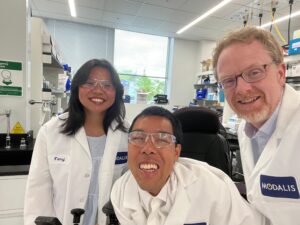
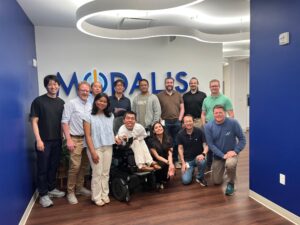
Justin Moy with his sister and Simon Moore from Modalis.
Everyone ate lunch together in a large conference room, so it was a great time to understand how the company worked from top to bottom. I further learned the distinction between a biotech and pharmaceutical company. Whereas a biotech company like Modalis focuses on mechanisms, safety, and efficacy, a pharmaceutical company focuses on upscaling, manufacturing and sales.
MDL-101
MDL-101, the code name for the LAMA2 treatment, is still in the preclinical validation phase. This means that it still has to go through clinical trials to test safety and efficacy in humans. Clinical trials are a multiyear process that requires the coordination of biotechs, manufacturers, regulatory agencies and patients.
Although MDL-101 may still be years down the pipeline, the fact that there is commercial interest is astounding! Even 10 years ago there was no indication that any LAMA2 treatment was on the horizon. It is because of dedication over decades by hardworking people that we have hope to possibly see treatment in our lifetimes.
At Modalis, I saw this dedication and willingness to collaborate first hand. The people there were passionate, focused, and excited to engage with our community. Everyone was especially grateful for the donation by Emily’s Future is Now, a LAMA2 foundation based in Switzerland. This visit would not have been possible without the international connections brought together through the in-person conference. A big thank you to Simon Moore and the whole team at Modalis. Sometimes all it takes is tacos!
– written by Justin Moy